2020 - 2023 · personal project, own capital
Crypto trading bot
A low-latency bot that caught short-lived, repeating price spikes in low-liquidity tokens and traded every repetition. It ran first on Kraken and later on decentralized venues such as Hyperliquid, and it was profitable until 2023.
What it did
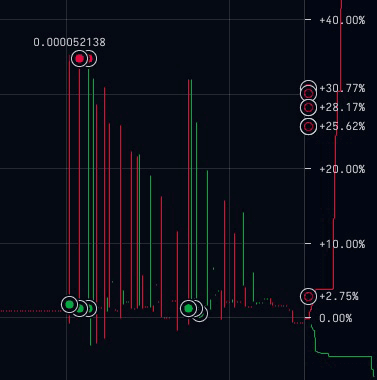
In thin markets, a sudden injection of liquidity often pushed the price up sharply, and the same spike then repeated almost identically several times within seconds. These moves happened at millisecond scale, far too fast for a human to react to.
The bot watched the market over WebSockets. It used the first spike to learn the pattern: where the price started and where it topped out. From the second repetition on, it bought near the low and sold near the high each time the pattern came back. Some events gave 10 to 12 round trips.
How it was built
Written in Go, mainly for its cheap concurrency: each market feed ran in its own goroutine, so detecting a pattern and placing orders never blocked each other. There was no database. Everything lived in memory, because the useful window was a few milliseconds and anything slower was worthless.
Risk and market impact
These were thin markets, so my own orders could move the price and kill the pattern I was trading. I capped every position at about 5% of the incoming liquidity. That kept the size of the strategy small, but it kept the pattern intact and the fills predictable.
Why it stopped working
From 2023 the market had much more liquidity. Short-term fluctuations became smaller and less repeatable, and the edge disappeared, so I stopped running it. Knowing when a strategy has stopped working is part of running one.
← Back to projects